The general category for posts on this blog.

The Desk That Helps

“Hello. How can I not help you?”

So, you have a company and you have customers and they might have problems with your products. You need to provide a method for them to redress those problems. First thing first, decide if you are building a Help Desk or a Call Center. Hopefully you are building a Help Desk, because if you aren’t, I will cut you.

Now that you are building a Help Desk, the next thing to do is determine the avenues you wish to open for support. Phone support is a tried and true method, but you can also do support by email, text, live chat, message forums… So many options. Which ones work best will depend on the type of products and services you provide, but the key is to just avoid confusion. It should be clear to your customers how to contact you and the level of feedback they should expect.

Feedback is very important. If I call and leave a message and then no one calls me back, I feel ignored. Next time I go to buy a product, I might not buy yours if there are other options. The same goes for emails and forums and texts… anything asynchronous needs to have a response time, a point by which you will either have an answer or you will contact the user and tell them you are working on it. I worked for a company once that funneled all support calls to a voice mail box, then when a caller left a message a pager would go off in the office, the person in charge of the pager would listen to the message, create the ticket, and assign it to a tech. We would only call the customer if the message was unclear. The tech would have 60 minutes to respond to the customer, either with an answer or to get more information. The important part is that we explained exactly how this worked to our customers, and while some people I know predicted we’d be flooded with messages that said “I have a problem, call me” the opposite happened. Our customers began leaving extremely detailed messages. Later we added an email address they could send problem descriptions and screenshots to. Again, some people predicted we’d get lots of “I have a problem, call me” emails, but instead we started getting well written narratives with pictures. It was great. But the point is that we established an expectation – report a problem, get contacted within the hour – and since we never ever failed at that, our customers worked to maximize that system, providing the best detail to speed response and increase accuracy of solutions.

Now, the next step is one that nearly all help desks/call centers I’ve interacted with fail at on some level. Assume you are in the business of providing phone service. Now assume half of your network has shit itself and half of your customers are experiencing problems. You need a way to communicate to your staff that the problem is known, how to identify if a caller/user is affected and what to say to them to explain the problem. If I call your help desk to report a phone service problem and your people there happily take my information, assign me a ticket number and tell me a technician will call me shortly without even a mention of a wide-spread outage, you have failed. And the failure will just get bigger because in an hour when I’m still having problems and no technician has called me back (because he’s too busy trying to fix the problem), I’m going to be furiously angry and possibly seeking out a replacement for your service. What would have fixed that? “Oh, this issue is linked with the current company wide outage we are experiencing. Our technicians are working to resolve it as we speak. I will put your name on our call back list to notify you of any significant updates or when a resolution is found.”

The final part of a good help desk (besides good help) is the followup. After the problem has been resolved, probably the next day, someone from your company is going to call the customer and ask them if everything is okay and if the problem was resolved to their satisfaction. Don’t outsource this. And I don’t mean to another country, don’t outsource this to people who don’t know anything about the problem. I work with one company and their followup call is a person who not only doesn’t know anything about the problem, the only thing they know is my name, my phone number and the problem ticket number. They can’t even tell me what the problem was, which is a problem when I have a half-dozen open tickets. 83759374 doesn’t tell me anything worth knowing. And when I ask, “Is this concerning the [insert problem description here]?” they can only reply, “I don’t know.” And I can’t fault them, because they don’t know, they haven’t been given the tools. However, I do fault the company, and it means they exist with one strike against them all the time.

I just don’t understand how so many companies can get something so simple, so basic as setting up a functional help desk that provides actual help and makes their customers feel helped. No, wait, sadly I do understand. Lots of people just don’t care.


Email: The Lost Art

I suppose I should entitle this something like “Reading & Comprehension: The Lost Art” because that’s really what’s about to happen, but since I’m most irritated with the way people treat their email, I went with this instead. Anyway, onward…

Let’s pretend I send you an email. And let’s pretend that in that email I ask you two questions. When you reply, answering only the first question and I have to send you another email with the second question, you look like an idiot. Emails aren’t twitter. Don’t stop reading at 140 characters. Read the whole damn thing.

Extending this, if you are sent an email asking you to do something – for example, to look into a previously reported problem and find out why it doesn’t appear to be being worked on – and your first thought is that you need more information – continuing the example, the ticket number of the original problem report – before you fire off an email asking for the information – “Do you have the ticket number?” – you should probably scroll down and read ALL of the emails in the chain – including the one right below the one you are replying to, in which the ticket number is given. When you don’t do this, you look like an idiot.

Some people – idiots – will defend this behavior, often citing reasons such as “I was reading this on my phone and the screen was too small.” As a solution, try this: Don’t read emails on your phone if you can’t properly read emails on your phone.

Lastly, sometimes when a company sends out an email – specifically an automated one – to which they do not expect a reply – probably because they are just informing you of a status or error – and within the body of the email, either at the top or the bottom or somewhere in between, it says “this email comes from an unattended mailbox, do not reply” or some variation thereof, when you reply to that email, get no response, and then later call up angry that no one replied to your email that you send to the totally non-functioning mailbox that the sysadmin only checks to see if it’s getting a large number of bounces or other error conditions, you look like an idiot.

Seriously, though, I’m saying this for your benefit – and mine – because you don’t want to be thought of as an idiot – and I’d rather get stuff done than repeat myself or listen to you complain about a problem that isn’t mine. For the sake of all that which you hold dear, read your damn emails! In full!

2012 and still they fail

NOlympicsIt’s 2012 and companies are still failing at The Internet.

The Olympics have begun, and NBC has made available every event online for streaming so you can watch them on your PC or tablet or phone. BUT only if you are already paying for TV. If you are one of those people who decided to cut the cord and go back to getting your broadcast TV by antenna or through websites on the Internet, then you are shit out of luck.

NBC had a real opportunity here. They could have allowed people to purchase an online package to get access to the feeds without needing to have Comcast or Cox or DirecTV or some other service. The pitch could have been, “Get access to all the Olympic events streaming on your PC, tablet and phone for $99!” with a perk of “Or, if you already pay for TV through one of our partners, get it for FREE!” Instead though, we are left with “If you are already paying for TV, get access to the Olympics events on your PC, tablet and phone for FREE!”

I really want to give NBC my money. I’d be willing to set aside a number of activities for a couple of weeks while the world’s best athletes compete for the gold, but I can’t. I cannot give NBC my money. Instead, I have to give Comcast my money, so that Comcast can give NBC a tiny fraction of that.

Well… fuck that! I’m not about to pay Comcast a bunch of money for access to 300+ channels I will never watch just so I can stream Olympic events to my PC, completely not using a TV, a set-top box (that Comcast requires) or even Comcast’s internet (since I’d be watching more stuff at work than at home).

This is crazy ass backward. I know why they do it though. It’s because the subscription cable/satellite business is too much to give up. It’s the same reason you can’t get HBO Go without already being a PayTV subscriber and already having HBO through that. I’d love to give HBO my money, but they won’t take it unless it comes filtered through Comcast and their ridiculous pricing plans that force me to get 300+ channels so I can watch 5.

Oh well, I guess I won’t be watching the Olympics. Maybe they’ll get this sorted out by 2016.

The AlphaSmart NEO

AlphaSmart NEO
You are the One, Neo. I have spent my entire life looking for you.

So, a month ago, I wrote about wanting an eInk writing device. I then purchased an AlphaSmart NEO from a seller on eBay for around $40. The idea is to have a tool, with a good physical keyboard and free from distractions, to take with me anywhere and be able to write. As bizarre as this thing may look, it’s actually pretty incredible. Though the memory is limited (not really) and you get only 8 files, the total storage capacity is around 72,000 words, which is enough to win the NaNoWriMo and then some. The screen IS small, but this isn’t an editing tool, it’s a writing tool. Just write, edit later. Boot up time? Instant. It saves after every keystroke. And it runs over 700 hours on 3 AA batteries. I’ve only used it about 50 hours so far.

I’ve hauled this thing with me to places like the Renaissance Festival, the back yard, the mall, work, the hospital. I get inspired, I bust it out and write. It helps that I’ve gotten into the habit of taking a small backpack with me most places.

One of the coolest parts of this device is how you get the files off. For most other portable electronic devices these days, you’d either be saving to “the cloud” or you’d plug it in via USB and drag & drop the files. The NEO, however, is a fully functioning keyboard. When you want to get a file off, you plug it into your PC with a USB cable, the PC recognizes it as a keyboard, you open the program you want your file in (Word, Notepad, Google Docs, WordPress, etc), put the cursor in the correct field, select the file on the NEO and press Send.

As an example, yesterday I had to take my father to the doctor. I also needed to write a review of a movie for Shakefire. I took the NEO with me and wrote the review while I was waiting at the doctor’s office. When I got home, it was lunch time, so I made some lunch. I then sat down in front of my PC, hooked up the NEO, opened up the entry form for the site and pressed Send. While I was eating, I got to watch as the NEO typed out my review. It types a little faster than I do – well, I probably beat it in raw typing speed, but it types at the same speed without stopping. And as it typed, I read. Because I could read comfortably and my eyes were incapable of glancing ahead (the NEO hadn’t typed it yet), this lead to more critical reading. It was as if I was reading someone else, not me.

In addition to the editing, there was a certain… gravity? weight? added by watching the words type out. Something very satisfying. I’ve written a lot in my life, but when I’m done I’m always done, the writing just is. Watching the NEO re-type everything I’d written, it just adds a level of “I wrote that” pride that I didn’t have before.

Another nicety, since this thing can’t do much more than write, I get more writing done. When I sit at a PC and write, if I have a question about what I’m writing, some detail, I’m tempted to Google it.  Doing so often leads to a lost twenty or thirty (or more) minutes reading sites, checking emails, and doing stuff that isn’t writing. The NEO allows for much more focus on my writing. Sure, there are programs you can get to disable your Internet access, but as easy as it is to disable it can also just as easily be re-enabled. With the NEO there is no Internet access to enable.

Anyway, I’ve written more in the last month than I did in the previous 5 or 6 before it. The freedom the NEO has given me is unparalleled. I can’t say I’d recommend the device to every writer, because every writer has their own style, but if you haven’t found a style that works best for you yet, I’d totally recommend giving one of these a shot. Buy one on eBay, and if it doesn’t work for you, sell it on eBay.

Signifying Nothing

This is a rant…

Recently it came to my attention that I was probably paying too much for my car insurance. Not because I saw a Geico commercial or anything, but because I was randomly musing about the fact that we have two cars, one a 1997 Volkswagen Cabrio and the other a 1998 Jeep Cherokee, and they are both (obviously) old, 15 and 14 years old respectively, and that they probably aren’t worth very much, each is worth – in theory – about $2,000 for private sale or maybe $1,500 trade-in value. We currently are sporting a policy with a $1,000 deductible. Given the worth of the cars, any accident which is going to cost more than the deductible to fix is going to be 50% or more of the value of the car, thus the insurance company is likely to just “total” the car and cut us a check instead of paying for repairs. So, it seemed silly to me to pay them what I was paying them for them to not really cover anything.

So, I called them up and cut my insurance payment in half, maintaining the medical coverage and the liability (damage to other people). They were very happy to do it and thanked me for my continued business and all was right with the world. Until…

Money to Burn
Like any average American, I have so much, I can do this. Not.

A couple hours later, I’m sitting there smiling about the money I’m going to be saving when it occurs to me that the value of my cars hasn’t changed much in the last couple of years. They’ve hit a sort of “value plateau” where the fact that they are running in good condition is the bulk of the value. Which means that I’ve been overpaying on my insurance for a couple of years. It’s going to total out to probably around $600 a year that I save, which means I’ve probably paid $1,200 to $1,800 for coverage I didn’t need.

Being a software developer, I know that it would be painfully simple to have a program that compares the coverage on a vehicle to the vehicle’s reported value (using something like the Kelley Blue Book as source) and this would generate a list of people to whom you could contact, by mail or email, and make them happy by offering to adjust their rates.

Of course, I know why they don’t do this. Something like auto insurance is seen by people as being required but interchangeable. They have to have it, and they pay more attention to the ads the companies run than to their actual policies. Most people will go to another company, get a quote and switch insurers before ever considering calling their current insurer to see if they can get a better rate. As such, companies focus more effort on signing new customer than on retaining existing ones.

For a non-insurance example, look at your local cable company. When was the last time they called to say they were running a special for all existing customers? Never, that’s when. The half price deals are for new or returning customers. Or for people who call to cancel. If you don’t leave and don’t complain, they’ll happily charge you twice what they charge new people, returning people, or people who threaten to leave.

Lesson: call your cable company every six months or so and threaten to cancel. Tell them you are switching to satellite, and then accept the new rate they offer to keep you.

You can probably do this with your garbage collection too, if you have to pay for it yourself and there is competition in your area. I’ve had the same company for a couple years, but where I was originally paying $30 a month, I’m down to $10 because they’ll “price match” any competitor’s offer, I just have to prove it’s a real offer. But they know who their competitors are, and they know what they charge. Why aren’t they sending out a letter to all their customers saying, “Hey! In appreciation for using us, we’ve reduced our rates!”

The other main reason they don’t randomly call existing happy customers to offer new lower rates is because those customer are, apparently, happy overpaying. Why would they throw away that money? Sure, being awesome for your customers might breed some loyalty, but loyalty is nothing in the face of cold hard cash.

Where am I going with this?

I have no idea. It all folds into that idea of “enough” I suppose. Some of these companies are making lots of money in profits, and they don’t reinvest that money into making the company better, nor do they reinvest it in reduced prices, they take it out of the system. Maybe they spend it back into the system somewhere else, but not at the rate it would get spent back into the system in the form of a few dollars into the pockets of thousands, tens or hundreds of thousands. Despite what the self proclaimed “job creators” tell you, a person, or small group of people, earning $5 million a month aren’t going to spend $5 million a month, but a million consumers saving $5 each on their bills are incredibly likely to spend that $5.

It just seems logical, for the better health of the entire economy… which is probably why I’ll never run a company or be in politics.

True Creation of Character

Dig through this blog and you will find a number of posts where I talk about the things that I think would make for a better MMO. These days I’m not playing (m)any MMOs, so I don’t pontificate about them anymore. But recently I got to thinking of an idea that just won’t get out of my head, so I’m going to put it down here in hopes to solidify it and keep it from nagging me.

City of Heroes - Character Creator
Kung-Fu Super Hero

One of my favorite parts of MMOs is character creation. Right now, most of you, probably nearly all of you, have an image in your mind that matches this screen shot. Selecting skin tones and body part shapes and clothing options. Admittedly, this stuff can be very cool. I absolutely adored the City of Heroes character creator. I probably built a hundred characters that I never actually played, because the idea of them was more grande than playing them would be, especially since I already had a few characters to play – and ultimately, once you start playing and you’ve picked your class, primary and secondary powers, characters play the same no matter what they look like. Still, a robust creator is a lot of fun and can ignite further character developments.

Which leads me to the other half of character creation, and the part that I end up liking more, when it works. As a role player, I love filling out the nooks and crannies of my character. Their back story, their hopes and dreams, and their personality. It is one of the reasons that I still hold the original EverQuest in just high regard. That game rarely ever tried to tell me who my character was, it was always left up to me. Since leveling was kill based and not quest based, I got to pick and choose which quests to do because they are what my character would do. This is completely opposite of what many people seem to desire in games: a constant barrage of “things to do”.

In EverQuest, I got to decide if I wanted to help the citizens of Qeynos with their problems. In World of Warcraft and other games, if I choose not to help the locals, not to do quests, I might as well stop playing because leveling my character without those quests is painfully slow.

Of course, dig through the posts here and you’ll see I actually advocate doing away with levels. Another thing I advocate is the design of EVE Online, because of the dichotomy of its character/skill system. In theory, it is a classless, skill based system. You get books to learn new skills, any skill you have the prerequisites for, and then you choose to learn it. (If you don’t know, EVE is a time based advancement system. You tell the game you want to learn a skill and it tells you how long. When it’s done, you pick another skill. You can do anything you want while training happens, nothing you do effects the speed.) However, in practice, EVE is a class based game. While any character can have any skill, once you leave port in a ship the only skills that matter are the ones that apply to the ship you are flying and the modules you have loaded in it. If you have level 5 in cannons and level 1 in missiles, when flying a ship with only missiles on it your cannons skill is unimportant.

The thing I like most about this design, and why I would like to see it implemented in a fantasy setting, is that it takes class choice out of the initial character creation. At the point you are making your first character, you don’t know anything about the class you are picking beyond the couple of paragraphs that the developers give you. Well, if you’ve played other MMOs, you probably can pick up on the tank/damage/healer elements of classes, which give you a leg up on the new players. And of course, the truth is, most classes play much differently at level 1 than they do at level 50 and beyond. I like skill based equipment limited design because it allows me to choose my role in the game as late as possible, and if I decide I don’t like being a tanking warrior, I can just switch and become a damage dealing light healer without having to abandon my whole character. I just get new skills and put on new gear. (And in a design without level based power curves, I could be useful in my new role immediately rather than having to power-level back up to join my friends.)

This got me to thinking. I want freedom, as much as I can get. But in my evolving design I still had new players making choices from limited sets before getting into game.

So, imagine this…

You log into the game and you hit “Create New Character”. You are then given a map of the world with the starting cities highlighted. Selecting a city takes you to a page (or pages) of the history of that city, a description of the land, the typical lives of the NPCs there (common professions, etc). You pick a story you like, this takes you to a more detailed description of the city, largely focusing on the factions within it. These descriptions leave out words like “good” and “evil” but instead rely on giving descriptions of the beliefs of these factions and their role in the history of this city. You have to choose a faction to align yourself with. Once you do, you are taken to the “character creator” where you get to pick the look of your character. On this screen is your character, in silhouette to start. Behind it is a representative selection of NPCs in the city you have chosen. Directly behind you and surrounding you are members of your chosen faction, and at the edges are members of the other factions. You aren’t limited in color palettes or textures based on any of your decisions so far, but the crowd around you gives you an idea of the world you will start in. You can choose to make yourself look like your chosen faction, or perhaps like one of the opposing factions – maybe you are a traitor! Or you can make yourself look entirely different from anything shown to you, a true outsider.

Now we get to the crux of my latest brain bothering idea. On this screen, there are a series of checkboxes and dropdowns and sliders and color selectors, all the familiar tools from every other character creator you’ve seen, but there are some differences. For instance, there is a dropdown called “Pronoun” from which you can choose “he”, “she” or “it” (or any additional pronouns we can come up with). This dropdown selects your character’s gender identity – notice, it doesn’t choose gender – and determines how NPCs and canned emotes will address you. Other checkboxes exist for “Breasts” and “External Genitals” (or something, it needs a better term). Checking those boxes will enable your character to have those items, no restrictions. Yes, you can have a penis, or breasts, or both, or neither! And all of them will have the appropriate sliding adjusters for shapes and sizes. There could even be an option for having only one breast, left or right – your choice. Are there other options? Any “normal” option that exists, like facial hair or tattoos or scars, would be available to everyone without limit.

Despite knowing that in such a system I would pretty much always choose to create standard built males, but that’s largely because I tend to create myself in games (No joke. Meet up with me in any game and if there is the ability to make a bald white goatee-wearing male that’s what I’ll look like. Meet up with me in real life and you’ll see I’m a bald white goatee-wearing male. I like to project me into other worlds rather than to become someone else. I want to meet other people, not be other people.), this idea that enables people to make any combination they want just seems awesome to me. Oddly enough, it’s because of, not in spite of, my predilection for making myself in games, because I want everyone to be able to do that, even if in real life they are a bearded man with breasts who identifies as asexual.

After building the look of the character, they would finally be taken to the skills area, where they would choose their initial skills. I wouldn’t want there to be classes, but I would want there to be sets of templates illustrating skills that would work well together and why, probably encompassing the traditional game roles for MMOs, with, of course, a Custom option where the player could pick their own initial skills from a list of all skills.

Essentially, I want to put as many decisions as possible into the hands of the players. And I want, as much as can be, those decisions to be informed decisions, and anywhere a player has to make a choices that may be considered less than properly informed I want them to be able to easily change them later without having to start all over again from scratch. I want them to choose what they play and how they play it.

Alright, I guess that’s enough out of me for today. Hopefully this all made sense.

Less of Me

Once again, I’m attempting to lose weight. It seems like I’m always trying to do that, but I suppose that will be the case until I finally get down to the weight I would like to be.

I bought a new scale. The old one, it seems, may have been broken. I weigh myself fairly often and noticed that I appeared stuck at 210 or there about. A little up, a little down, but not much. On a whim, I decided that I wanted a digital scale instead of the old non-digital one we had, plus it was only $12. Anyway, first time I step on – 217. My other scale had been lying to me. Oddly enough, the previous couple weeks I’d been doing the light eating again, so I suspect that I was at 220 or so. I’m down to 216 and trending downwards.

Trending… that’s another key this time around. I’ve got a Google Doc spreadsheet I’m using to track my weight. I’m weighing myself 3 times a day – morning, after work, before bed – and recording the lowest weight for the day (because it makes me feel better), but that weight is less important than the moving average. The average will give me a better picture of where my weight really is by smoothing out the fluctuations that occur from retaining water, the occasional big (heavy) meal, and more. Also, by adding “Science!” to my daily routine it feels more like a real project and not just “eat less, exercise more”.

Speaking of exercise, I have a 10k to run in under a month, so, you know, I should probably get to training a bit. The past year has been fairly shitty for me in regards to exercise and diet so I expect to do worse than I have in the previous two years. I did, however, download a Couch-to-5k program for the old Zune that I plan on beginning, maybe this weekend. Also, you know, Rule #1 of the Zombie Apocalypse: Cardio.

Another common element of my “I’m going to start a diet” plan is cutting out sodas, which I’m doing again. Consistently, I’m drinking less sodas now that I used to – there was a time where I was drinking a 6-pack of can sodas a day plus whatever I got out at meals. Now I drink mainly on the weekends and sometimes after hosting a party at our house I’ll have some left over hanging around, and I have little to no willpower, and I refuse to let things go to waste. Oddly enough, as I was thinking about cutting out sodas again, I ran across this wonderful little infographic.

CDC: The New (Ab)Normal

It really makes me not want to eat fast food anymore. Or at the very least, order the smalls and from the value menus. It would help my ego if they stopped calling them “junior” or “kid’s” sizes, but I think I’m just going to have to get over it. I may also start ordering food from the kid’s menu at other restaurants or trying to split a meal with the wife or something. Portions are really out of control.

Also, the CDC has some really awesome stuff about diet. Which makes sense, now that over-eating and obesity are being considered diseases. You can start with the source of that infographic here.

Anyway… enough about me being fat. I return you to your regularly scheduled Friday.

eInk Writer’s Companion

I like to write. I hate to write sitting at my desk. I would love to be able to write anywhere. Being a left hander brought up in a school system that refused to teach left-handed writing styles, I have horrible form and it hurts to write manually for extended periods, which prevents me from using pen and paper for any long form writing. I love computers. I have a completely bizarre typing style that has developed over years that doesn’t result in any discomfort or carpel tunnel issues. And when I say write anywhere, I mean anywhere, including sitting on a beach in broad daylight.

So, what I really need is essentially an eInk Kindle, in landscape mode, perhaps a slightly longer/wider screen, with an attached clamshell keyboard – a real keyword, for use with fingers not just thumbs. It could have wi-fi, but really only for some sort of wireless sync. All I need it to be able to do is create new document files, open existing document files, save files, delete files and support some form of hierarchy so that I can associate multiple documents to each other – such as chapters to a book – and see it visually. Something that simple, with no need for additional software and browsers and Internet and such, could run for hundreds of hours on a single charge, and being that the files are only text, a small amount of memory can go a very, very long way.

I know these days people and companies are in love with multi-function devices. Phones that are also music players and cameras and PDAs and web browsers and email clients and so on and so on. But I still like my single function devices too. I like having a Zune for my music/podcasts and nothing else. I like having a Kindle for reading books. And I would love to have a device that is simply for writing and not for gaming and a million other functions.

Looking around at other simple eInk tablets/readers that exist, I think this could be put together and sold for around $79, probably less, and at that price I’d buy one in a heartbeat. Unfortunately, I doubt such a thing would ever exist. It’s too simple, and whenever I bring up the idea to someone they always respond with either “Get a Tablet” or “Get a Netbook”. I have a netbook and a Kindle Fire, and neither of them are what I want – mostly because the screens are less than useful in sunlight, and the Fire lacks a full physical keyboard. Plus, the battery life on them both is terrible. 8 hours? Bah!

I’d be happy to be wrong though. If there is an eInk document writer with a full keyboard, let me know. I’d be forever in your debt.

Enough With The Secrets

I can’t say that I have any insider knowledge, because I don’t, but in light of the recent events surrounding 38 Studios and their Project Copernicus (no links, just Google it) I figured I’d throw up a post about a tangential topic.

Want to know how not to generate true excitement for the game you are developing? Give out no details of the world or game, no videos, no screen shots, nothing, but keep saying, “We are building a really great game and world and we can’t wait for you to see it!”

If you can’t wait… don’t!

When Green Monster Games first announced they were beginning work on an MMO and started hiring people, I was excited. Then they changed their name to 38 Studios and hired more people. They announced they were working with Todd McFarland and R.A. Salvatore somewhere in there, and I was excited. And then… nothing. For years the only thing we heard was “We are building a really great game and world and we can’t wait for you to see it!”

And now we probably never will.

Every game, every developer, I think believes they have something special and awesome that they have to keep a secret, to protect it from being stolen or to save it for that shocking unveiling. The problem is, if it goes on too long, you end up with only the rabid fanboys still interested and the casual observers move on to companies who actually do more than say “We are building a really great game and world and we can’t wait for you to see it!”

Maybe 38 didn’t have anything to show? I doubt it… the video that came out in the last week and the screen shots that have trickled out, and the comments by former employees saying things like “When I left the office today for the last time, our servers were still up, running the whole world with tens of thousands of NPCs going about their business. I choose to believe that they’ll be there, remembering us forever.” I think they had plenty to show, but, for whatever reason, they didn’t.

Now we just have to wonder, if they’d been less secretive, if they’d shown more progress, could they have attracted investors and saved the game?

To everyone who used to be a part of 38, I’m sorry this happened and wish you the best in your future endeavors.

Movie Going

In my opinion, there is almost nothing quite as fantastic as seeing a good movie in the theater. The superior sound and the giant screen enveloping your vision and sucking you right into the story. Even the audience matters. Listening to people enjoying the movie too is part of the greatness. The gasps and laughs, the sniffing of stifled tears. It is unique and wonderful. But increasingly it isn’t worth the price of admission.

Before we even get to the literal price, there is so much more that is wrong with the movie going experience. As much as I love the idea of crowds, the reality of them is always so much less. If your kids aren’t capable of sitting still for a couple of hours and watching a movie, don’t bring them – get a sitter. Not only will everyone else enjoy the movie more, YOU will enjoy the movie more. Also, don’t go to the movies if you have trouble following plots. Nothing will annoy your neighbors more than you constantly asking your friend what’s going on. And if you aren’t enjoying a movie, consider leaving and asking for your money back rather than decide for everyone that this drama should be a comedy by adding your lame remarks in your loudest voice.

People who text or talk on cell phones during movies should be shot. And I’m not being hyperbolic here. Security should come in, drag the texter out of the theater, take them to a room and shoot them. Perhaps just in the hand. Maybe take off a finger, the little one. I bet if they lost a finger they’d stop texting during the movies. Assholes.

And theaters should be required to maintain a certain level of quality. There is a theater near me that I almost never go to because, as I say, “You pay for one movie and you get to listen to two!” The sound barrier between their screens is so poor that you literally get to hear two movies. If your movie is the loud action pack thrill ride, no problem, but if your movie is the dramatic quiet tear jerker, listening to soldiers bark commands and things explode while the main character of your film is supposed to be silently weeping his loss kind of ruins things. At the very least, theaters with shitty quality should charge shitty quality prices.

But before I get to ticket prices, it would be remiss not to mention the concession stand. I can buy a bag of popcorn at the grocery store for about a $1.50, so I wouldn’t be surprised to have to pay $3 to but the same amount of popcorn at a theater where they serve it to me – the people have to get paid somehow. But having to pay $5 to $7 for that amount of popcorn is stupid. And I’m not even going to bother with the $7 sodas. What?!? But what about those $3.75 to $5.75 boxes of candy that are only half filled? I understand that the theaters need the revenue, but every facet of their concession stand appears to be designed to make me angry and never want to buy anything there. These days I don’t even bother. Despite the hanging of signs saying it is forbidden, I bring my own soda and snacks to the movie. And don’t try to sell me on the “but if you buy a large you get free refills!” stuff, because I never leave the theater during the film if I can help it. Why on Earth would I miss part of the movie I just paid that much to see?

Which brings us to the ticket prices. My local theaters are between $9 and $12 for an evening ticket. The $9 is for a theater that is of lower quality. Of course, when I do go to see a movie, I pretty much always go to a matinée on the weekend, before noon, where the price is often $6, maybe $7, for the better quality houses. Still the price is high. For the wife and I to go see a movie it’s going to cost $12 to $24, just for the tickets. And for my money we get to see the movie one time. Whereas if I wait six months, I can buy the movie on DVD or Blu-ray for around the same price, and own the movie – which I can watch as many times as I want or watch it once and then sell it to get some of my money back.

I haven’t even gotten into the latest trend: 3D. Currently, you pay a premium for 3D, an extra $3 to $5 per ticket. They’ll tell you that the extra cost is to cover the glasses (which they ask you to give back so they can recycle them) or to recoup the cost of upgrading their projectors. If that’s true, though, at some point they should finish recovering the projector cost and glasses production & recycling should level off that the premium should go away. It should become standard. Of course, that’ll never happen as they will be too busy enjoying the extra profits. And you know it’s all about the money as every movie seems to be getting a 3D release – and most of those are post-production conversions, not filmed in 3D with special cameras.

I am a movie lover. And back in the days of tickets being $5 to $6 and a concession combo (drink & popcorn) was $4 to $5, I’d go see a movie every single week. It was what I did on a Friday or Saturday night. Now, they’ve doubled the prices and the result is that I never get concessions and I see a movie once every couple of months. And I have to imagine that I’m not alone. These days, my Friday or Saturday nights are often spent streaming a movie off Netflix or Amazon where I pay a movie ticket a month for unlimited streaming of thousands and thousands of movies. I don’t know who is to blame for the skyrocketing prices – the theater companies, the movie producers, someone else – but I do know that it is pricing me out of the market.

I read an article once, and I wish I could find it again (but I think it was in print, not on the Internet), that Hollywood and theater owners were both lamenting “event movies” – stuff like The Avengers, the Harry Potter films, Avatar – movies that draw people into theaters.  Part of their lament was that smaller films just didn’t sell in theaters, and it was only these giant budget risks that stood a chance. I can’t help but think that they’re looking at everything all wrong. The problem is that it’s only these huge “must see” films that get people to ignore the high cost of admission. At half the price, at $6 or $5… or in my dream world $3, I feel people would be a lot more willing to take a risk on a movie. For $3, I would pretty much go see any movie in the theater – even if it was poorly reviewed, for $3 I’d be willing to judge it for myself. On the other hand, for $12 (or $15 in 3D), the movie better be well reviewed and give me two hours worth of awesome entertainment or else not only will I be unhappy but I’m likely to avoid going to the movies for a while. Once bitten, twice shy and all that.

So what do I recommend? First off, do some research on the movies you are going to see. Check this list, and if the movie says it was originally filmed in 2D, see it in 2D. Don’t reward people for going for the 3D cash grab. Second, go to weekend matinées. See the movie at 11am, then go for lunch, do some shopping, whatever, make a day of it – but start with the movie. Plus, if you eat breakfast, and then see a movie with the plan to get lunch after, you don’t need movie snacks, just sit back and enjoy the show. And third, find local theaters with good quality sound setups and stick to them. Reward theaters for being good theaters.

That third step can be the most difficult as movie distribution is a scam just like everything else. The best local theater nearest me doesn’t get all the best movies. They have 24 screens and didn’t get The Avengers, the 16 screen house down the road with lower quality got it. Two different movie theater companies, but they are serviced by the same distributor who ensures they take turns on the blockbusters and don’t compete. Lame.

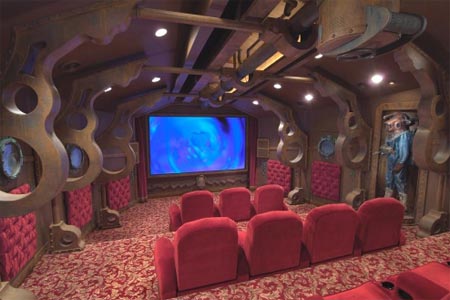
You know… on second thought, you should probably just invest in a quality home theater instead.

This isn't my personal home theater... yet.